The Kelly Criterion in Sports Betting: How Much to Bet When You Have an Edge
You've found a bet you like. You think the underdog at +150 wins 45% of the time, and the price says the book thinks it's closer to 40%. Good. Now the question nobody asks until it's too late: how much do you put on it? Ten bucks? Half your bankroll? The Kelly criterion answers that with math instead of mood.
The Kelly criterion is a formula that sizes each bet as a percentage of your bankroll, based on your edge and the odds. Bet more when your edge is bigger, less when it's smaller, and nothing when there's no edge at all. Followed exactly, it gives the fastest long-term bankroll growth possible, but only if your win probabilities are right. Since they never are exactly right, most serious bettors use a fraction of it. Getting those probabilities is a matter of handicapping each game well.
The Kelly formula
Here's the Kelly criterion formula:
f = (bp − q) / b
f is the fraction of your bankroll to bet. b is the net odds, what you win per dollar staked, which is the decimal odds minus 1. At +150, b is 1.5; at -110, b is 0.909. p is your estimated probability of winning, and q is 1 − p, your chance of losing.
The top of the fraction, bp − q, is your expected profit per dollar. Divide it by the odds and you get the bet size. So the formula is really just edge divided by odds: a big edge at short odds deserves a bigger bet than the same edge on a long shot, because the long shot loses more often along the way.
John Kelly Jr. worked this out at Bell Labs in 1956, originally for a problem about sending signals over a noisy phone line. Ed Thorp later used it to size his blackjack bets, and it's been part of serious betting strategy ever since.
Worked example: the +150 underdog
Back to that underdog. Odds +150, so b = 1.5. You estimate a 45% chance of winning, so p = 0.45 and q = 0.55.
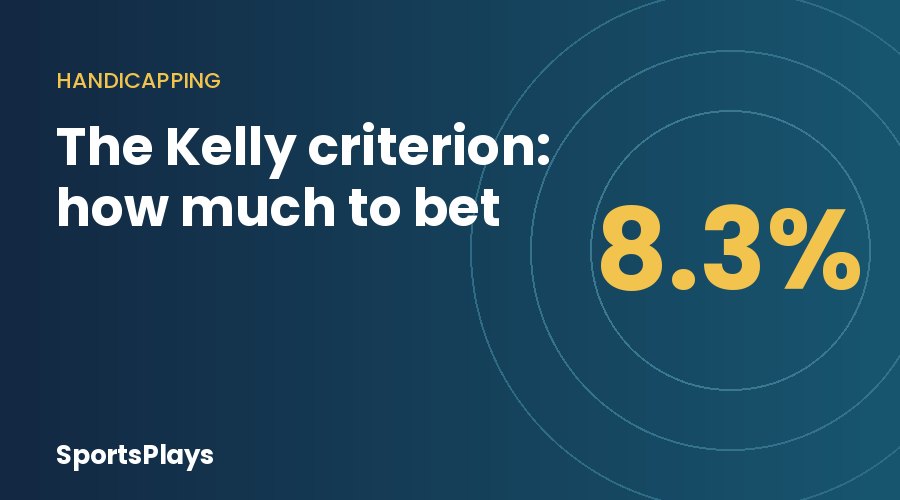
f = (1.5 × 0.45 − 0.55) / 1.5 = (0.675 − 0.55) / 1.5 = 0.083
Kelly says bet 8.3% of your bankroll. With $1,000, that's an $83 wager. The expected value is strong here: every dollar bet is worth about 12.5 cents on average, which is why the Kelly bet is fairly big.
Now change one thing. Say your honest estimate is 40%, not 45%. f = (1.5 × 0.40 − 0.60) / 1.5 = 0. At +150, a 40% chance of winning is exactly break-even, so Kelly says don't bet. One estimate, five percentage points apart, is the difference between an $83 bet and no bet at all.
Worked example: a -110 spread
Most sides and totals are around -110, where the numbers get small fast. At -110 you need 52.4% just to break even, so here's what Kelly says at each win probability:
| Your win probability at -110 | Full Kelly | Half Kelly | Quarter Kelly |
|---|---|---|---|
| 52.4% | 0% (no bet) | 0% | 0% |
| 53% | 1.3% | 0.65% | 0.33% |
| 54% | 3.4% | 1.7% | 0.85% |
| 55% | 5.5% | 2.75% | 1.4% |
| 57% | 9.7% | 4.85% | 2.4% |
Winning 55% of your spread bets over a long stretch is very good, and even then full Kelly says 5.5% of your bankroll per bet, half Kelly under 3%. If you've been betting 10% of your money on every game you like, the formula is telling you something, and it isn't flattering.
Full Kelly vs. fractional Kelly
Full Kelly is mathematically optimal only if your probabilities are exactly right. They won't be. And the formula is lopsided about mistakes: bet too little and you grow a bit slower; bet too much and you can grow slower and swing wildly at the same time. Bet twice the Kelly amount and your expected growth rate drops to roughly zero, with huge volatility on top, which is why overbetting is the expensive error.
That's why most sharp bettors use fractional Kelly, usually half or quarter. At -110 with a true 55% win rate, half Kelly keeps about three quarters of full Kelly's long-term growth while cutting the size of every swing in half. That's a trade we'd take every time.
There's a second reason to use fractional Kelly. Bettors almost always overestimate their edge. You think it's 55%; it's 53%, or 52%. If you bet full Kelly on a perceived edge of 55% when the truth is 52.4%, you're betting 5.5% of your bankroll on bets with no edge at all, and the vig grinds you down. Half or quarter Kelly gives you room to be wrong.
Where your win probability comes from
This is the hard part, and no Kelly calculator can do it for you. The formula needs a probability, and that probability has to come from your handicapping: your own line, a model, or a market price you trust more than the one you're betting into.
One honest way to start is with the market itself. Convert a sharp book's odds into no-vig probabilities, compare them with the price you're getting, and the gap is your edge. That's how value betting works, and our guide on spotting value walks through it. Then check whether you're right over time. Beating the closing line on a regular basis is the best sign your probabilities are any good; we cover it in our CLV guide.
If you can't put a real number on your chance of winning, you can't use Kelly. Flat betting a small percentage of your bankroll is the honest choice until you can.
Practical problems with Kelly
Kelly assumes one bet at a time, settled before the next. Sports betting doesn't work that way: you might have eight NFL bets riding at 1 PM on Sunday. Betting full Kelly on all of them at once overbets the bankroll. Size them down so the total at risk stays sensible.
Kelly also assumes your bankroll is your bankroll. Recalculate your bet size from your current bankroll, not the one you started with, so bets shrink after losses and grow after wins. That's what protects you from going broke.
And it doesn't care about how a losing streak feels. Even half Kelly can draw you down 30% or more during a normal cold run. If that would make you chase losses or quit, bet smaller. Bankroll management only works if you can stick to it.
Kelly for underdogs, favorites and parlays
The formula works the same way at any odds. With an underdog, the bet size stays modest even with a decent edge, because you lose more often. With a heavy favorite, the bet size can look large, since you win often, but the edge on a big favorite is usually tiny or negative once you account for the juice.
Parlays are where Kelly mostly says no. The math works if you know the true probability of every leg, but a small error in each leg compounds, and the bookmaker's margin on parlays is bigger. You'll rarely find a parlay with a clear positive expected value, and when Kelly gives you a negative number, the answer is don't bet.
How to use Kelly without hurting yourself
Set aside a betting bankroll you can afford to lose. Estimate your win probability honestly, and be stingy about it. Run the Kelly formula, then bet a quarter to a half of what it says; that's where we'd keep it. Cap any single bet at a few percent of your bankroll regardless. Track every bet so you find out whether your estimates hold up; a proper bet log is how you learn your real edge.
Better yet, practice the whole thing first without money on the line. SportsPlays gives every player a Free Bet Balance on real lines, so you can size bets with Kelly, watch your bankroll move and see whether your edge is real before any of it costs you.
SportsPlays is for players 21 and over. If betting ever stops being fun, call or text 1-800-GAMBLER for free, confidential help.
FAQ
What is the Kelly criterion in simple terms?
What is the Kelly criterion formula?
Should I use full Kelly or half Kelly?
Does the Kelly criterion work for parlays?
What does it mean when Kelly gives a negative number?
Build a streak today
15 in a row = $100 · 21 in a row = $1,500 · Free to play.
 Would Your AI Football Picks Survive a Public Leaderboard?November 17, 2026
 How to Handicap NHL Games: A Hockey Betting Guide to Goalies, Shot Quality and PriceNovember 17, 2026
 How to Handicap College Basketball: A Step-by-Step Tempo-Free MethodNovember 16, 2026