How to Handicap NHL Games: A Hockey Betting Guide to Goalies, Shot Quality and Price
It's 11:30 in the morning, and the morning skate just told you something the opening line didn't know: the starting goalie is taking the night off. Within an hour, the moneyline moves 20 cents. If you'd already made your number with the backup in net, you got the good price. If you hadn't, you got the leftovers.
To handicap NHL games, start with who's in goal, then rate both teams on their five-on-five play (shots and the quality of those shots, not goals), adjust for special teams, rest and home ice, and turn the result into a win probability. Convert that probability into a fair moneyline and bet only when the sportsbook's price is better than yours. That's the core handicapping process with hockey's quirks: a sport where one player in net can swing the game and a lucky bounce decides more of the scoring than anyone likes to admit.
Hockey is a low-scoring, high-luck sport
An NHL game usually has five or six goals. With that few scoring events, a deflection off a skate or a puck that hits the post and stays out changes the result. Over a handful of games, the standings tell you who's been lucky as much as who's been good.
For anyone who wants to bet on hockey seriously, that cuts both ways. Win-loss records and goal totals mislead you, and most casual hockey bettors lean on both. The stats that predict future results are the ones measured over many more events: shot attempts and, even better, the quality of those shots.
Goalie first, everything else second
We'd put more weight on the goaltender than on any other single factor in NHL betting, the same way baseball bettors start with the pitcher (it's the starter-first logic we use for MLB).
The math backs that up. Say a team allows 30 shots a game. A goalie who stops 91.5% of shots gives up about 2.55 goals on those 30 shots. One who stops 90% gives up 3.0. That's roughly 0.45 goals a game from one position, in a sport where the average margin is small.
Two rules we follow:
- Don't bet before the starter is confirmed, or at least projected with confidence. Morning skate reports and the team's beat writers usually tell you by midday.
- Judge a goalie on a big sample and on goals saved compared with the quality of shots he faced, not on his record. A goalie behind a bad defense can face tougher shots every night and still be better than his save percentage says.
Rate the teams at five-on-five
Most of an NHL game is played at even strength, so that's where you rate teams. The useful numbers:
- Shot attempt share (often called Corsi): of all the shot attempts in a team's games, what share does it take?
- Expected goals (xG): each shot weighted by how likely it is to go in, based on where it came from and what kind of shot it was
- Expected goals share at five-on-five, adjusted for score, since teams that lead tend to sit back and give up more shots
Expected goals is the one we lean on most. A team that's out-chancing its opponents but losing is a team the market might be underrating. A team that's winning with a weak xG share is living on hot shooting or a hot goalie, and that rarely lasts a full season.
PDO helps sort that out. Add a team's even-strength shooting percentage and save percentage. Over a season, most teams land near 100. A team running far above that for a month is due to come back down; one far below is probably better than its record. Treat it as a reason to dig deeper before you bet.
Special teams, then rest
Power plays and penalty kills take a smaller share of the game than five-on-five, but they still decide plenty of them. Look at how many penalties a team draws and takes, not just its power-play percentage. A great power play is worth less against a team that rarely goes to the box.
Then check the schedule. Back-to-backs matter in the NHL, mostly because the second night is when backup goalies play, and partly because of fatigue and travel. A team on its fourth game in six nights, flying across time zones, will usually look a step slow. The market prices the obvious ones, so make your adjustment and compare it with the line rather than assuming the tired team is a fade.
Home ice is worth something, though less than home court in basketball. Part of it is the crowd; part is that the home team gets the last line change, so the coach picks the matchups he wants. Rate it modestly and don't stack it on top of everything else.
From probability to an NHL moneyline
Hockey is a money line sport; most bettors bet on the NHL there rather than on a point spread. Once you have a win probability, turn it into a price and compare it with the implied probability of the sportsbook's odds.
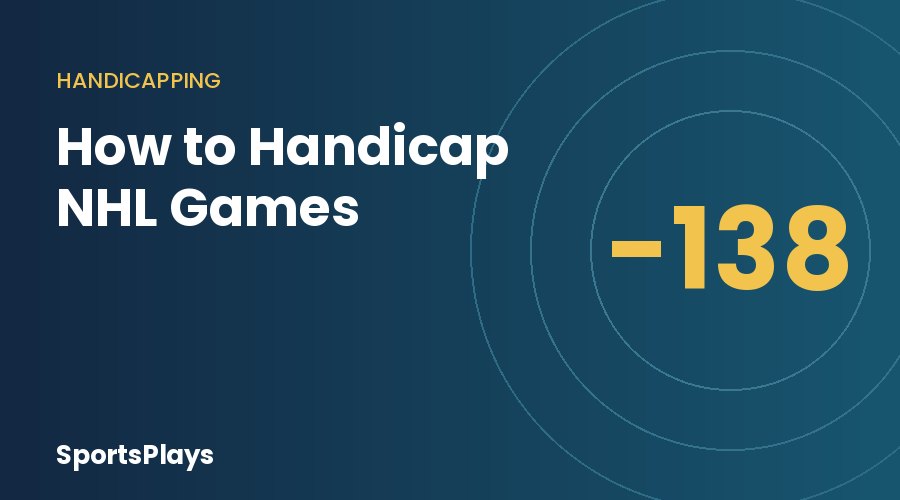
Say you make the home team a 58% favorite, overtime and shootout included. A fair moneyline for a favorite is probability ÷ (1 - probability) × 100, then make it negative: 58 ÷ 42 × 100 ≈ -138. If the book offers -125, that price implies only 55.6% (125 ÷ 225), and you're getting a better number than your fair line. If the book says -150, pass.
Remember that the standard moneyline includes overtime and the shootout. A regular-season game tied after 60 minutes goes to three-on-three overtime, then a shootout, which is close to a coin flip. That's one reason big NHL favorites are rarely as safe as they look, and why underdogs at plus money deserve a real look (we lay out when the plus-money side is the smarter price). If you'd rather avoid overtime entirely, regulation and three-way lines treat a tie as its own result, and they pay more for that.
The puck line and the empty net
The puck line is hockey's run line: the favorite at -1.5, the underdog at +1.5. Because the favorite has to win by two, the -1.5 side usually pays plus money, and the +1.5 side costs a lot of juice.
The empty net changes the math. A team trailing by one late in the third period will often pull its goalie for an extra skater, and that gives up plenty of empty-net goals. So a lot of one-goal games turn into two-goal games in the last two minutes. When you price a puck line, estimate how often the favorite wins by two or more, including those late empty-netters. A -1.5 at +160 needs to cash 38.5% of the time to break even (100 ÷ 260).
Hockey totals, periods and timing
A total is a wager on the number of goals scored by both teams combined. NHL totals sit around 5.5 or 6.5, and most of the action is in the juice: an over 5.5 at -130 is a different bet from 5.5 at +110. Project goals from both teams' expected goals for and against, adjust for the two goalies, and compare with the posted total and its price. Read your sportsbook's house rules on how overtime and the shootout count toward the total before you bet one.
If you have a strong opinion about how a game starts (a team that's sharp early, or a goalie who tends to give up early goals), first-period hockey lines are a way to bet just that part of the game.
Timing: NHL odds usually open the day before, and the biggest moves come with goalie news. If your edge is in the team ratings, bet early. If it depends on who's in net, wait for the confirmation and accept a slightly worse price for the certainty.
Props, live betting and the playoffs
NHL player props (shots on goal, points, goalie saves) follow the same logic as everything else: project the number, then compare. Shots on goal are the most predictable because they depend on ice time and role, which you can see in the team's line combinations. A skater bumped to the top power-play unit gets more shots, and the prop doesn't always catch up the same day.
Live betting on hockey rewards patience. A team that's down a goal but outshooting the other side 15-5 after the first period is often a better price in-game than it was before puck drop. Just remember that a two-minute penalty can change the game while you're tapping the bet slip.
The Stanley Cup playoffs are their own animal. Teams play the same opponent up to seven times in a row, coaches shorten their benches, and referees tend to call fewer penalties than in the regular season, so special teams decide fewer games. Totals in the NHL playoffs often come in lower for that reason. Home ice still counts, and a goalie who gets hot for two weeks can carry a weaker team a long way, which is why Stanley Cup futures on a team with an elite goalie are a bet we'd at least price out.
We'd stay away from NHL parlays built from three or four heavy favorites all season. Each leg adds the book's margin, and hockey sends more games to overtime than any other major North American league.
Common NHL handicapping mistakes
Betting a team because it has won five in a row. Streaks in hockey are mostly about shooting percentage and goaltending running hot, and you're buying at the peak.
Laying -250 on a favorite because the other team is bad. You're putting a $250 wager on a $100 win in a sport where a bad bounce and a shootout can beat anyone.
Ignoring the goalie until puck drop. By then the price has moved.
Judging yourself on a week. Hockey's variance is brutal over small samples; a simple log of every bet you make over a few hundred games will tell you whether your numbers are any good.
Try your numbers on SportsPlays
Every night of the NHL season, the moneyline, puck line and total for every game on the schedule are on SportsPlays' NHL odds, and you can bet them with your free balance. Check which teams the public is backing in hockey tonight before you lock in, and see how your read stacks up against the free expert NHL pick of the day. If you want something to play for, the monthly contest on SportsPlays takes moneylines, puck lines and totals at -140 or longer, and the standings are on the contest standings page.
The bettors who last in hockey are the ones who check the goalie every single time, and who are fine taking +130 on a team that's better than its record.
SportsPlays is for players 21 and over. Set a budget before you bet and stick to it; if gambling stops being fun, call 1-800-GAMBLER for free, confidential help.
FAQ
What's the most important factor when betting on NHL games?
Are NHL puck lines a good bet?
Does the NHL moneyline include overtime and the shootout?
What is PDO in hockey betting?
Is it better to bet on hockey before the game or live?
How should I handle back-to-backs in the NHL?
Build a streak today
15 in a row = $100 · 21 in a row = $1,500 · Free to play.
 Would Your AI Football Picks Survive a Public Leaderboard?November 17, 2026
 How to Handicap College Basketball: A Step-by-Step Tempo-Free MethodNovember 16, 2026
 How to Handicap College Football: Ratings, Tempo and a Betting Strategy That Holds UpNovember 15, 2026